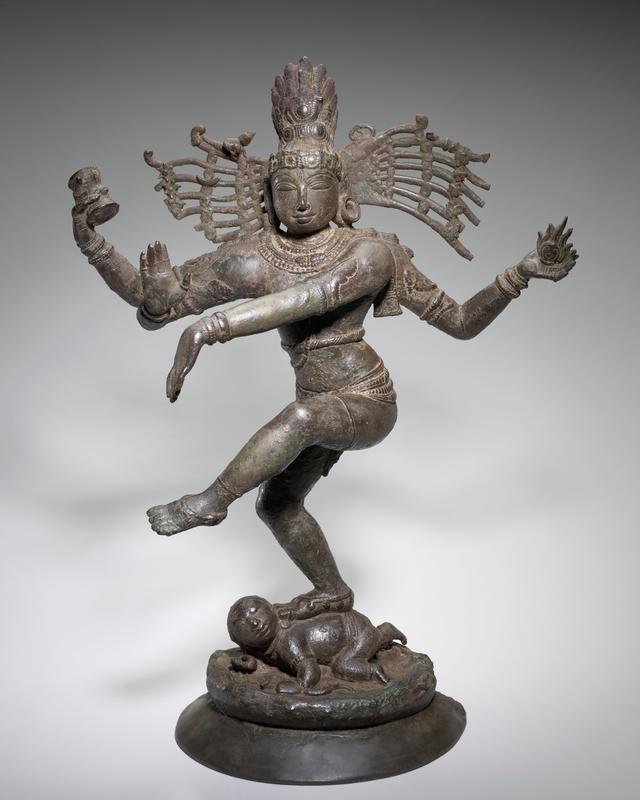
Shiva Nataraja (Lord of the Dance), c. 1100
Unknown artist, Indiaexpand_more
Bronzeexpand_more
Gift of Mrs. E. C. Galeexpand_more 29.2
On View in Gallery 211expand_more
The Hindu god Shiva appears in several incarnations. Here, Shiva appears as Nataraja, or Lord of the Dance. He raises his left foot in a graceful dance pose. In his upper right hand, Nataraja holds a drum, the sound of which manifests creation. The flame that he holds in his upper left hand symbolizes destruction. Together, they symbolize the creation and destruction of the cosmic universe. The posture of the icon’s lower left and right palms signifies protection. The foot that rests on the demon’s back symbolizes the elimination of ignorance, while the raised left foot signifies salvation. A now missing ring of fire, symbolic of the simultaneous and continuous creation and destruction of the universe, would have encircled the bronze icon.
Explore
Audio
Artstory

Details
- Title
- Shiva Nataraja (Lord of the Dance)
- Role
- Artist
- Dimension
- 28 in. (71.12 cm)
- Accession Number
- 29.2
- Curator Approved
This record has been reviewed by our curatorial staff but may be incomplete. These records are frequently revised and enhanced. If you notice a mistake or have additional information about this object, please email collectionsdata@artsmia.org.
Does something look wrong with this image? Let us know

Zoom in on the left to the detail you'd like to save. Click 'Save detail' and wait until the image updates. Right click the image to 'save image as' or copy link, or click the image to open in a new tab.